This study is not intended to be the only Bible study on the subject; rather, it is a guideline for further study of your own.
I Am, in the Old Testament
We read in Exodus how God explains to Moses who He is, and what Moses must say to the people when they ask him who sent him to them.
14And God said to Moses, “I AM WHO I AM.” And He said, “Thus you shall say to the children of Israel, ‘I AM has sent me to you.’” – Exodus 3:14
In the original Hebrew it is written as follows:
אֶהְיֶה אֲשֶׁר אֶהְיֶה (ehyeh asher ehyeh) – I AM WHO I AM.
This is how God identifies Himself. He then tells Moses to give the people the shortened version of His name: I AM. There is no indication of time, and no past or future. He was before everything, and will still be after everything. Simply I AM. This I AM is a personal name. Here we already see the forerunner of what Jesus would say about Himself many years later. The Greek translation of the Old Testament, the Septuagint, uses the phrase Egō eimi. It is the same phrase used in the New Testament.
I Am, in the New Testament
John 8 describes Jesus Christ’s mission on earth. The bystanders, especially the scribes, are sceptical. Study the chapter to get the context. He speaks about Abraham, and how he would rejoice to see the day when Jesus completes His mission on earth. When the scribes remark that He is not yet fifty years old and yet claims to have seen Abraham, He links Exodus 3:14 to the present and shows that He is God in person, the expected Messiah, and truly timeless:
58Jesus said to them, “Most assuredly, I say to you, before Abraham was, I AM.” – John 8:58
No past or future. Simply I AM. Notice that Jesus does not say “before Abraham was, I was”, but “I AM” – the very name God gave Moses. Here we have the revelation of Jesus Christ as God Himself, with no beginning or end. Now they have no excuse. It is no wonder that the scribes wanted to stone Him. The truth hits hard, and yet their eyes were blinded to it, as is still the case today (Romans 11:8). In this regard, read Isaiah 53, the “forbidden” chapter for the Jews. Jesus is now truly God with us, for those who want to see Him.
We read the same thought in John 18:4–5 when Jesus was arrested. When Jesus asked the soldiers whom they were seeking, and they answered, “Jesus of Nazareth”, He replied: “I am He.” What the Greek actually says is Egō eimi – I am. The word “He” was added later by the translators. Some English Bibles print it in italics to show that it did not appear in the original Greek.
I Am, for you today
What does this mean for you today? Let us look at a few statements Jesus makes about Himself. Each of these statements is a fulfilment of the Old Testament, and each shows the true character and heart of God the Father, now embodied in His Son. He wants the best for us. God cares about you and wants to give you the best.
-
John 6:35, 41, 48, and 51:
35And Jesus said to them, “I am the bread of life. He who comes to Me shall never hunger, and he who believes in Me shall never thirst.”
This follows the miracle of the feeding of the 5,000, which we read about in John 6. Food was scarce, most people were poor, and Jesus brought abundance out of almost nothing. Yet He wants to satisfy not only our physical hunger, but also a deep-seated spiritual need.
Old Testament reference: Exodus 16 – the manna in the wilderness.
-
John 8:12; and 9:5:
“I am the light of the world. He who follows Me shall not walk in darkness, but have the light of life.”
Just like food, light was also scarce. There were no streetlights at night, just as there was no light in the wilderness at night. During the Feast of Tabernacles (John 7), the Jews lit lamps as a symbol of how God had led the nation through the wilderness. Because He announces that He is the light of the world right after this, the feast was still fresh in their minds. If Jesus is your light, you need not be afraid of the dark.
Old Testament reference: Exodus 13:21 – the pillar of fire by night showed the travelling Israelites the way.
-
John 10:7 and 9:
“I am the door. If anyone enters by Me, he will be saved, and will go in and out and find pasture.”
This is the forerunner of the next statement, that Jesus is the good shepherd. Jesus is the door through which we go to the Father.
Old Testament reference: Psalm 118:19–20 – the gate of the Lord.
-
John 10:11, 14:
“I am the good shepherd. The good shepherd gives His life for the sheep.”
What was a shepherd like in Jesus’ time? The sheep would see the shepherd standing at the entrance to the fold, and enter only there. The shepherd would examine them for any wounds or injuries. He cares for them and counts the sheep as they enter the fold. If one is missing, He leaves the others in the fold and goes to look for the lost one. See Matthew 18:12 and Luke 15:4. This is what Jesus does for me. He comes to fetch me where I have strayed.
Old Testament reference: Ezekiel 34 – the good shepherd and the bad ones. Read this chapter carefully. It is an indictment of the Jewish religious leaders. Jesus refers to it in John 21:15 when He restores Peter to his position and explains to him how he would become a leader of the church. Modern pastors who are focused only on themselves should perhaps also read Ezekiel 34.
-
John 11:25:
“I am the resurrection and the life. He who believes in Me, though he may die, he shall live.”
Jesus refers to the death of Lazarus, whom He raised shortly afterwards. He proves that death has no hold on us. Death is not the final step.
Old Testament reference: Isaiah 53:10. Isaiah 53 is the forbidden chapter for the Jews. It is also of cardinal importance for us in reaching Jewish people. Study it.
-
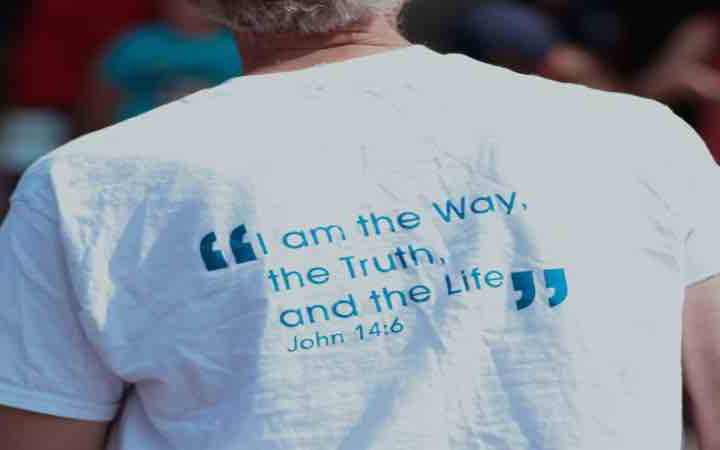
John 14:6:
“I am the way, the truth, and the life. No one comes to the Father except through Me.”
This statement is in response to what He said earlier – He is not merely a way; He is the way; He is not merely a truth; He is the truth; and He is not merely the life for now; He is the life, after this life.
Old Testament reference: Exodus 26:33 and Leviticus 16. The veil that was the separation between man and God was torn in two. Through Jesus there is no longer a separation between the Holy Place and the Most Holy.
-
John 15:1:
“I am the true vine, and My Father is the vinedresser.”
Jesus speaks these words before He would die for the sin of mankind. The truth of this passage is that you must remain anchored in the true vine, Jesus Christ Himself. You cannot do it on your own. Without the source there is no life in you.
Old Testament reference: Isaiah 5:1–7 and 27:2–6.
Think about it
In every case the Greek phrase Egō eimi is used, followed by a noun. How many statements does He make about Himself?
What does this tell you about God’s revelation of Himself to mankind? What does “seven” mean in God’s order, and what examples can you give of seven or sevens in the Bible? Go and do some research on this.
How can you apply Jesus’ seven “I am” statements to yourself? He is:
- the bread – my food, provision, sustenance, and growth in a world that serves up whatever the media says as my food for the day;
- the light – my focus in a world where darkness is gaining the upper hand. Light drives out darkness;
- the door – my only access to the Father, while the world tells me there are many ways to be saved;
- the good shepherd – my protection and care (Psalm 23:1), while the world does not care about me at all;
- the resurrection – my hope for the future while the world has nothing to offer me, and holds up the lie that there is no resurrection;
- the way, the truth, and the life – my compass, focus, and assurance, where the world proclaims many wrong ways, lies, and death; and
- the vine – my source and sustenance, where the world drains me through the demands it places on me.
Which of the above do you need from the Father?
He gives you everything through Jesus Christ. Think for a moment about what your greatest need is right now. Which one of Jesus Christ’s “I am” statements to mankind can you identify with, and in what way does it meet that need?
Perhaps you need Egō eimi to become a reality for you today. For Moses and his followers it was enough that God identified Himself as I AM. Today it is still the same.