Isaiah 53
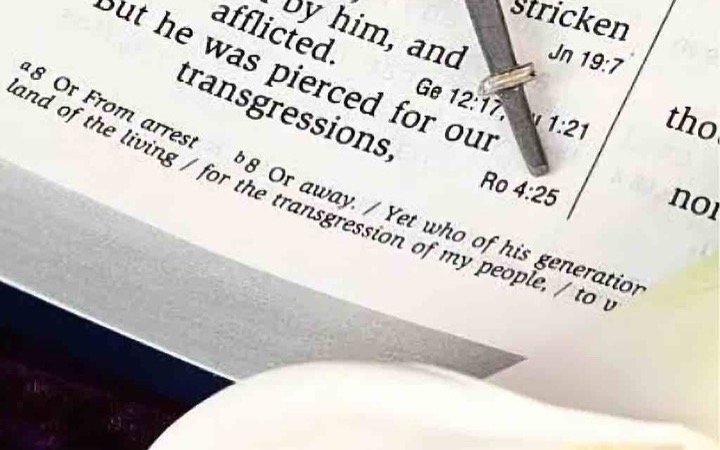
This article is not intended to be the only Bible study on the subject; rather, it is a guideline for further study of your own.
The forbidden chapter for the Jews
In this study I ask you not to look at theology, but simply at what the Word says. For many years the Jews have not wanted to read this chapter of Isaiah’s prophetic book, precisely because it speaks of the Messiah, while they would rather see the Servant as Israel itself. That is not possible. Yet it is exactly this chapter that is leading many Jews to Jesus today, as they begin to wake up spiritually. See Jeff Morgan’s website www.highway53.org. But it is not only Jews who are touched by it.
What does this chapter tell you about your position in Jesus Christ?
Isaiah 53
We read from Isaiah 52:13. That is where the chapter really begins, and it is the chapter the Jews do not want to read. Isaiah 53 is often referred to in the New Testament. The prophet wrote these words 800 years before the events took place, and they were recorded in the finest detail.
Isaiah 52:13: My Servant, Jesus Christ, as the Jews will experience Him in the future. There are four passages about the Servant as Isaiah received them. First read Isaiah 42:1 (quoted in Matthew 12:17–21) and then Isaiah 49:6 (quoted in Acts 13:47), where Jesus is first identified as God’s Servant. Then follows Isaiah 50:10. The fourth time Jesus is referred to as the Servant is in Isaiah 52:13. He was the Servant who served, rather than being served. Where do we read about this in the New Testament?
Isaiah 52:14: The impact of the scourging before and during the crucifixion.
Isaiah 52:15: The millennial reign in the future. See Romans 15:21.
Isaiah 53:1: John refers to this in John 12:38, and Paul in Romans 10:16.
Isaiah 53:2: The gospel must never be wrapped in pretty gift paper. That is what the devil would like to see happen. It must be presented for what it is and for what it represents to us. It is not always pretty to us, but it is necessary.
Isaiah 53:3: Few people paid attention to Jesus’ ministry, both the Jews to whom He came first, and the Gentiles.
Isaiah 53:4: He accepted responsibility for the sin (griefs and sorrows) of others (mine!) and made it His own.
Isaiah 53:5: He received what should have come our way. Through His death (His stripes) life came to us.
Isaiah 53:6: We all wandered like sheep without a shepherd, but Jesus comes as the good Shepherd and brings us into His fold. See John 10:11–14.
Isaiah 53:7: See Matthew 26:63 and Mark 15:5. See also Acts 8:32.
Isaiah 53:8: He was cut off (put to death). See Daniel 9:26: “Messiah shall be cut off”. “My people” refers to Israel, and Daniel’s prophecy is about Israel.
Isaiah 53:9: The plan was probably for Jesus to be buried with the other two who were crucified (the wicked), but then Joseph of Arimathea asked for His body and buried Him alone in his own grave, that of a rich man. See Matthew 27:57–60.
Isaiah 53:10: “It pleased the LORD” means He gave His full consent and was glad. Those who are saved through Him will see Him, and He will see them.
Isaiah 53:11: Our justification is the main point. By bearing our guilt He had us declared righteous, and “many” (so not all) are justified. Not everyone will accept this gift. See Romans 5:9, 21. We have already done a study on justification (see our series on Soteriology).
Isaiah 53:12: In His distress He prayed for those who transgressed against Him. See Luke 23:34.
Isaiah 53 and its New Testament fulfilment
The table below shows how each verse of Isaiah 53 is quoted or fulfilled in the New Testament. Quotations are from the New King James Version.
| Verse | Isaiah 53 text (NKJV) | New Testament reference | New Testament connection and text (NKJV) |
|---|---|---|---|
| Isaiah 53:1 | “Who has believed our report? And to whom has the arm of the LORD been revealed?” | John 12:37–38 Romans 10:16 |
Quoted directly to explain why people rejected Jesus despite His miracles: “Lord, who has believed our report…” |
| Isaiah 53:2 | “For He shall grow up before Him as a tender plant… He has no form or comeliness; and when we see Him, there is no beauty that we should desire Him.” | Mark 6:3 Philippians 2:7 |
Reflects Jesus’ humble, ordinary background as a carpenter, and that He took the form of a bondservant. |
| Isaiah 53:3 | “He is despised and rejected by men, a Man of sorrows and acquainted with grief…” | John 1:11 Luke 19:41 |
“He came to His own, and His own did not receive Him.” Also seen where Jesus wept over Jerusalem. |
| Isaiah 53:4 | “Surely He has borne our griefs and carried our sorrows; yet we esteemed Him stricken, smitten by God, and afflicted.” | Matthew 8:16–17 | Quoted directly after Jesus healed the sick: “He Himself took our infirmities and bore our sicknesses.” |
| Isaiah 53:5 | “But He was wounded for our transgressions, He was bruised for our iniquities… and by His stripes we are healed.” | 1 Peter 2:24 Romans 4:25 |
Quoted directly by Peter: “by whose stripes you were healed.” Also connects with Jesus being pierced on the cross (John 19:34). |
| Isaiah 53:6 | “All we like sheep have gone astray… and the LORD has laid on Him the iniquity of us all.” | 1 Peter 2:25 2 Corinthians 5:21 |
Peter writes: “For you were like sheep going astray, but have now returned to the Shepherd…” Paul says that God made Him who knew no sin to be sin for us. |
| Isaiah 53:7 | “He was oppressed and He was afflicted, yet He opened not His mouth; He was led as a lamb to the slaughter…” | Acts 8:32 Matthew 27:12–14 |
Quoted directly in Acts 8 by the Ethiopian eunuch; fulfilled when Jesus remained silent before Pilate and the chief priests. |
| Isaiah 53:8 | “He was taken from prison and from judgment… for the transgressions of My people He was stricken.” | Acts 8:33 | Quoted directly in Acts 8: “In His humiliation His justice was taken away, and who will declare His generation?” |
| Isaiah 53:9 | “And they made His grave with the wicked — but with the rich at His death, because He had done no violence, nor was any deceit in His mouth.” | Matthew 27:57–60 1 Peter 2:22 |
Fulfilled in Jesus’ burial in the tomb of Joseph of Arimathea, a rich man. Peter quotes the end of the verse: “who committed no sin, nor was deceit found in His mouth.” |
| Isaiah 53:10 | “Yet it pleased the LORD to bruise Him… When You make His soul an offering for sin, He shall see His seed, He shall prolong His days…” | Acts 2:23–24 Hebrews 10:10–12 |
Points to God’s purpose and plan in the crucifixion, Jesus’ once-for-all offering for sin, and His resurrection (“He shall prolong His days”). |
| Isaiah 53:11 | “He shall see the labor of His soul, and be satisfied. By His knowledge My righteous Servant shall justify many…” | Romans 5:18–19 1 John 2:1 |
Paul echoes it directly: “so also by one Man’s obedience many will be made righteous.” |
| Isaiah 53:12 | “…because He poured out His soul unto death, and He was numbered with the transgressors, and He bore the sin of many, and made intercession for the transgressors.” | Luke 22:37 Mark 15:27–28 Hebrews 9:28 |
Quoted by Jesus at the Last Supper (“And He was numbered with the transgressors”), fulfilled between two robbers on the cross, and reflected in His intercession (Romans 8:34). |
Holy Communion
With this text in mind, how will you approach your next Communion? The prophetic word is inspired by the Spirit. Know the Word. Stop sinning.