The purpose, plan, and method of God
19 February 2021
[ Previous article in the series... ] [ Return to Soteriology main page... ]
According to Thiessen (Thiessen, 1949), the means of grace is the Biblical doctrine of the method God uses to bring man to salvation. This is the final lesson in our series on Soteriology. If you have followed each lesson, you will no doubts be amazed at the plan God has made in His wisdom, to provide man a way back to His presence. This is done only through the blood of Jesus Christ. There is no other way to salvation. [ See this article for more information… ]
 Definition
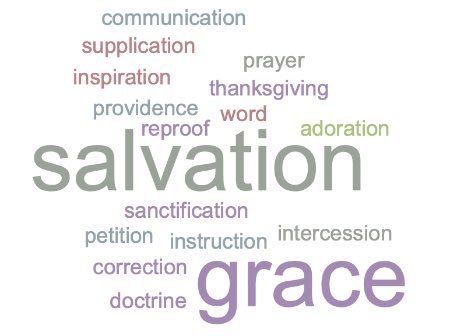
The fact that man sinned in the garden of Eden should effectively disqualify him from all possible pardon and ever being in the presence of God again. However, in His grace, He has provided the opportunity for man to come to salvation.
The means of grace
God’s grace for the unbeliever comes through two sources – His Word, and prayer.
The Word of God
The Word of God refers to the Bible – the Old Testament and the New Testament, as the accepted canon of the Bible, excluding the apocryphal books and anything else not contained in our Bibles today. The Bible is a divinely inspired book and as Paul points out to Timothy:
16All scripture is given by inspiration of God, and is profitable for doctrine, for reproof, for correction, for instruction in righteousness: 17That the man of God may be perfect, thoroughly furnished unto all good works. – 2 Timothy 3:16-17
Note Paul’s key word, doctrine. Throughout this website, we emphasise doctrine as the way to keep us on the right path. In our time already, we are seeing how true Biblical doctrine is being eroded, and changed to become the false doctrine of man. Paul warned Timothy that this would happen:
1Now the Spirit speaketh expressly, that in the latter times some shall depart from the faith, giving heed to seducing spirits, and doctrines of devils; – 1 Timothy 4:1
Paul says that the entire Bible is firstly inspired by God, then that it is useful for doctrine, and then he adds to this that it serves to reproof (verbally correct someone who applies doctrine incorrectly); for correction (correct incorrect doctrine); and for instruction (instruct people in correct doctrine); in righteousness (that the person can understand the true doctrine and live by it to please God). Thus, the Bible is profitable for:
- Doctrine (Biblical teaching)
- Reproof (Verbal correction)
- Correction (correcting incorrect doctrine through teaching)
- Instruction (instructing and teaching people how to correctly apply the Word of God)
The effect of all of this is so that man may be perfect, and fully prepared to live a life of faith, through which good works will follow. Is it possible to live a perfect life? It is, else Paul would not have told Timothy why scripture is important.
The Word of God is like a hammer that shatters a hard rock; a judge that knows the intentions of the heart; a mirror through which we can measure our own standing; a method for cleansing ourselves; a seed that grows in us; food for those who hunger; a lamp as a guide; and a sword for the soldier.
It is a method of salvation
The Bible is one method to lead an unbeliever to repentance and eternal life. Paul refers to the gospel (the “good news”) as the power of God that leads to salvation:
16For I am not ashamed of the gospel of Christ: for it is the power of God unto salvation to every one that believeth; to the Jew first, and also to the Greek. – Romans 1:16
He is adamant that everyone can come to salvation through the gospel, whether you are a Jew (representative of the Law and the Old Testament and the strict adherence and interpretation of the laws contained in them) or a Greek (representative of the gentiles and the mentality of often meaningless arguments based on human law). Note that he states that the Jew is first in line for salvation, even if they are often the hardest to be converted.
The gospel Paul writes about encompasses the death, burial and resurrection of Jesus Christ and it is the preaching of the same that leads people to repentance and acceptance.
It is a method of sanctification
The Bible is there to sanctify man and it uses different methods:
We look into a mirror (the Word) and we see our own shortcomings, not to leave us in a state of despair, but to show us the areas where we have not yet conformed to the likeness of Christ.
18But we all, with open face beholding as in a glass the glory of the Lord, are changed into the same image from glory to glory, even as by the Spirit of the Lord. – 1 Corinthians 3:18
It is a lamp and a light, a guide and a beacon, for our spiritual walk in faith. If we walk in the light of the Word, we will never falter:
105Thy word is a lamp unto my feet, and a light unto my path. – Psalm 119:5
The purpose as the Word as a lamp and light is twofold: it serves as a lamp for my immediate situation, where I am walking now, and it serves as a light that guides me on my future path where I am heading on, towards meeting Jesus Christ in person, when we will see Him as He is.
It is also a sword, which I need to spiritually fight of the onslaught of evil:
14Stand therefore, having your loins girt about with truth, and having on the breastplate of righteousness; 15And your feet shod with the preparation of the gospel of peace; 16Above all, taking the shield of faith, wherewith ye shall be able to quench all the fiery darts of the wicked. 17And take the helmet of salvation, and the sword of the Spirit, which is the word of God: – Ephesians 6:14-17
It is the truth. When Jesus prayed for the disciples, He asked the Father to sanctify then in the truth, for His Word is the truth (John 17:17).
If you want to grow spiritually, do not (just) read what man says about the Bible, read the Bible itself and see what God says!
Prayer
When you read the Bible you will see how often prayer is the focus.
Nehemiah prayed about the desperate state of the walls of Jerusalem, while he was in captivity:
4And it came to pass, when I heard these words, that I sat down and wept, and mourned certain days, and fasted, and prayed before the God of heaven, – Nehemiah 1:4 (Read the entire part, from verse 4 to 11, to understand the heart of Nehemiah.)
In the same way Daniel prayed and interceded for his own people:
3And I set my face unto the Lord God, to seek by prayer and supplications, with fasting, and sackcloth, and ashes; – Daniel 9:3 (As with Nehemiah, read the entire prayer of Daniel, from verse 3 to 19.)
Jesus spent a lot of his earthly ministry devoted to prayer. He would often seek a lonely place, such as a mountain, to go and pray. The entire chapter 17 of John’s gospel is devoted to His intercession for His disciples.
We should do the same. Often, our prayers are self-centred, instead of reaching away from ourselves towards the needs of others.
The nature of prayeer
- Prayer is communication between us and God. If you want to be a genuine prayer warrior, start with confession. The two examples of Nehemiah and Daniel are perfect examples of confession of sins. We may look at their situation and think that they were not responsible for what those left behind in Israel were doing while they themselves were in captivity. However, they demonstrate the necessity of confession and intercession and they include themselves. Note that both use “we”, including themselves. Jesus did not need to confess any sin, but He effectively interceded for His disciples, and by implication, all believers who would be the result of the work of the disciples.
- Prayer is adoration. We absolutely must give God the adoration He as Creator deserves.
- Prayer is communion. We here communicate with God, not with an everyday person.
- Prayer is thanksgiving. We thank God for who He is and for his goodness.
- Prayer is petition. We make our requests known to God, not that He does not already know this, but to show our dependence on Him.
- Prayer is supplication. We urge God to listen to our petition in the same way Daniel and Nehemiah did.
- Prayer is intercession. Daniel, Nehemiah and Jesus are examples of prayer warriors who interceded on behalf of others. We can intercede for rulers (This is often a difficult one, yet we are admonished to pray for our leaders and rulers.); the unsaved; new converts; all saints; backsliders; Christian workers; and even our enemies.
The relationship between prayer and providence
There is a lot of debate whether prayer can really be effective. If God is sovereign and already knows everything, then how can our prayers change His mind? Will God always answer our prayers? Often, He does not, not because He cannot, but because He has a greater plan. Does it mean that when our prayers are not answered that we sinned or that He cannot? In Matthew 26:24 we read that Jesus asks the Father if this cup (what He was about to endure) could possibly pass Him by, but He understood that it was in the Father’s plan that He had to drink this cup (endure what was to come).
We need to understand that there are times when our prayers may not be answered. When our wishes are clearly self-centred, they will not be answered, to protect us from the consequences. If we do something really stupid, prayer will not help. I cannot jump off a bridge and then quickly ask God to give me wings for a safe landing. Gravity and the effects thereof are part of God’s creation and we would be foolish to try to act against it.
However, God still answers prayer, and this is not because we have twisted His arm, but because in His omniscience, He already knows the prayer, the mindset, and the outcome.
The method and manner of prayer
Our path as believers towards the ultimate goal includes that we will spend a lifetime in prayer, learning to pray, and correcting ourselves. The disciples, while in the presence of the greatest prayer warrior, asked Jesus to teach them how to pray (Luke 11:1) and He gave them a basic structure around which they learned the method, and we use the same today.
- Who do we address?
We pray to the Father (Nehemiah 4:9) and the Son (Acts 7:59). While we are not told that we can pray to the Holy Spirit, 2 Corinthians 13:14 may imply prayer to the Holy Spirit. However, the Holy Spirit prays in us (Romans 8:26) instead of Him receiving our prayers.
- What is the posture?
No posture is prescribed, but many are indicated: standing (Mark 11:25); kneeling (1 Kings 8:54); lying on the ground (Matthew 26:39); lying down in bed (Psalm 63:6); sitting down (1 Kings 18:42); and even hanging on the cross (Luke 23:43). In the end, it is not the posture, but the attitude, that is important.
- At what time should we pray?
We are admonished to pray always (Ephesians 6:18) as well as having fixed times (Daniel 6:10). While this should not be seen as an absolute rule, it lays the foundation for a life of prayer. We pray before meals(Matthew 14:19), and during special occasions (John 6:15). In the end, God is always waiting for our prayers.
- Where should we pray?
The Bible places emphasis on private prayer (Matthew 6:6); a solitary place (Mark 1:35); even a mountain(Matthew 14:23). However, there are also many examples of prayer in public (Acts 16:25); with people in difficult times (Acts 27:35); and ultimately, in every place (1 Timothy 2:8).
- What should our presentation be like?
We are taught not to have a gloomy or sad presentation but be presentable (Matthew 6:16-18). We shouldrefrain from meaningless repetition (Matthew 6:7ff); and in an orderly fashion, especially in church (1 Corinthians 14:40).
- How must the condition of the heart be?
We have to abide in God. Jesus says if we abide in Him, and His words abide in us, our prayers will be answered (John 15:7). This means we must be aware of sins that we know of (Psalm 66:18); our requests must not be selfish (James 4:2ff); we must ask according to His will (1 John 5:14); we must first forgive those who have done anything against us (Matthew 6:12); we must ask in the name of Jesus (John 14:13ff); pray in the Spirit (Ephesians 6:18); ask in faith (Matthew 21:22) and persevere (Luke 18:1ff).
Ultimately, we are called to persevere [ See the previous lesson… ] in this life, as well as in prayer.
Conclusion
Just do this:
17Pray without ceasing. – 1 Thessalonians 5:17
Bibliography
Thiessen, H. C., 1949. Lectures in Systematic Theology. 3rd Edition ed. Grand Rapids, Michigan: Eerdmans Publishing Company.
[ Previous article in the series... ] [ Systematic Theology... ]